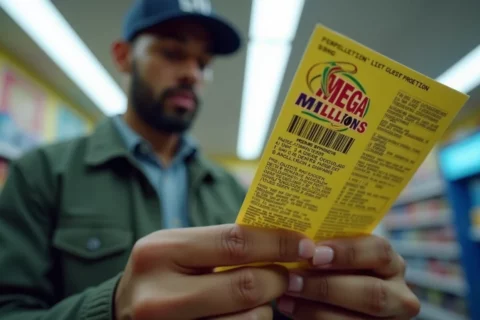
A Florida lottery ticket just did what every jackpot ad promises and almost no headline ever explains: it turned into a number that looks obscene at the top and much less theatrical after the math gets involved. The prize attached to the July 28, 2026 Mega Millions draw reached $803 million, but the cash sitting behind that headline is $345.5 million before taxes take their slice.
That gap is the whole story. The winning ticket was bought in Bradenton, Florida, and the jackpot ended up as the biggest Mega Millions prize of 2026. The winner did not wake up with an $803 million bank balance. They won the right to choose between a long, annuity-style payout and a much smaller lump sum. The difference between those two numbers is where the fantasy becomes arithmetic.
The jackpot everyone sees
Mega Millions posters love the big number because it is the point. The advertised figure here, $803 million, is the annuity value, spread across 30 annual payments. The structure stretches the prize over time, with each installment rising by 5 percent from one year to the next.
That number makes people stop scrolling. It sounds like a private island, a fleet of houses, and enough generational security to annoy relatives for decades. It is also the least liquid version of the prize.
The more practical figure is the cash option, which in this case comes in at $345.5 million. That is the present-day value of the future annuity stream, the amount the lottery is effectively willing to hand over now instead of paying over three decades. It is still a staggering sum, but less than 43 percent of the headline jackpot.
Jackpot snapshot
- Advertised annuity: $803 million
- Cash option: $345.5 million
- Draw date: 28 July 2026
- Purchase location: Bradenton, Florida
- Status: Largest Mega Millions win of 2026
The number after the tax man
A Florida winner pays no state income tax on lottery winnings. That helps, but the federal government will still be waiting at the door.
The initial withholding on the cash option is 24 percent, meaning $82.92 million disappears immediately. That leaves $262.58 million in the account before the final bill is settled. The prize pushes the winner into the top federal bracket, so the effective tax on most of the money lands at 37 percent. Using that rate, the estimated federal liability on the $345.5 million cash option is $127.835 million.
That puts the rough spendable amount at $217.665 million.
This is still life-altering money, obviously. It buys freedom, options, and a very large margin for error. It also cuts the size of the dream down to something more usable. People hear $803 million and start mentally filling a hangar. The tax-adjusted figure decides whether the hangar even makes sense.
The fantasy gets expensive fast
A sudden fortune invites bad shopping lists. The first version of the fantasy is usually the easiest to imagine: a house, a better house, a house by the water, maybe another one somewhere colder, warmer, or easier to disappear in. The trouble starts when the purchase price is only the opening bid.
A $10 million to $30 million home does not sit still. Property taxes can run into the low millions over time, depending on location. Insurance is another hefty line item, as are landscaping, utilities, security, cleaning, repairs, and staff. A mansion that looks like the answer to everything can become a very expensive place to sleep if the owner never budgets for the machinery around it.
The same is true of other jackpot fantasies. Private jets are not just tickets with wings. They bring fuel, hangar fees, crew, maintenance, insurance, and pilot salaries that can climb into the millions a year. Yachts are worse in their own way, because the purchase price is only the invitation. Annual operating costs often run at 10 to 15 percent of the vessel’s value. A $20 million yacht can quietly become a $2 million or $3 million annual habit.
Even the more glamorous domestic dreams have a maintenance bill. Exotic cars need storage, specialist servicing, and insurance. Family travel at luxury levels can consume astonishing sums once it includes private charters, security, and the kind of hotels that charge more for a view than some people pay for rent in a year.
The smart version of sudden wealth
Winners who keep their money usually stop thinking like shoppers and start thinking like custodians. That means putting structures around the windfall before the windfall starts making decisions for them.
Trusts are one of the first tools people reach for. A revocable living trust can keep assets private and avoid the public mess of probate later. An irrevocable trust gives up more control but can offer stronger protection. A spendthrift trust is built to stop fast hands from emptying the cupboard too quickly. A family limited partnership can help move wealth around with more control and less chaos.
Then there is philanthropy, which sounds softer than it is. A private charitable foundation can turn a one-time jackpot into a long-term public footprint, while also giving the winner a formal way to direct money rather than scatter it. None of this is about making the prize smaller. It is about keeping the prize from evaporating into a parade of beautiful mistakes.
The Bradenton ticket is a reminder that lottery wealth has layers. The headline makes people dream. The cash option makes them count. The tax bill makes them honest. And the maintenance costs are where the fantasy either grows up or gets eaten alive.