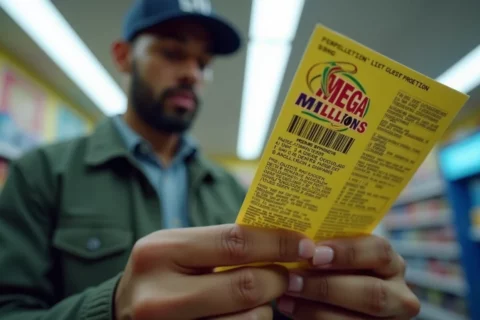
A single forgotten click stood between one Illinois player and half a billion dollars. When the first attempt to buy a Mega Millions ticket fizzled out on the state lottery’s website, “Lucky Lady” nearly walked away from what would become one of the game’s largest payouts ever. She didn’t. A second try on March 10, 2026, generated a Quick Pick entry that matched every winning number for a $536 million jackpot. A technical hiccup became the kind of origin story lottery marketing departments dream about.
The Digital Ticket That Almost Wasn’t
The failed transaction itself never made headlines. Payment glitches, expired cards, and momentary platform overloads happen thousands of times daily across online lottery systems without consequence. For Lucky Lady, the specifics remain private, but the pattern is familiar enough: a would-be player enters details, hits submit, and somewhere between bank and server, the request dies. Most people shrug and move on. She came back.
That return visit is the precise mechanism online platforms are built to encourage. Saved account details meant no re-entry of personal information. Stored payment methods eliminated the friction of fetching a wallet. The Illinois Lottery’s system remembered her, welcomed her back, and produced a randomly generated set of numbers in seconds. A convenience store purchase demands physical presence, cash or card in hand, and a clerk’s attention. The digital equivalent asks almost nothing. The ticket materialized as a database entry, not thermal paper, and sat waiting in her account until the draw changed everything.
When the Paper Slip Disappears
Physical lottery tickets carry a particular weight. They crinkle in pockets, get pinned to refrigerator doors, or tucked into wallets with a nervous reverence. Their destruction means destruction of the claim. Digital tickets invert this relationship entirely. Lucky Lady’s winning entry could not be dropped in a puddle, left in a taxi, or accidentally laundered. It existed as an encrypted record, backed up and traceable, tied to her verified identity from the moment of purchase.
This security comes with its own vulnerabilities. Account passwords become the new safe combinations. Phishing attempts targeting lottery players have grown more sophisticated as jackpots swell and online participation rises. The Michigan woman who won $3 million through the state app in 2021 discovered her fortune only after dredging through a spam folder, her winning notification buried among phishing scams pretending to be winning notifications. Her ticket was secure, but her awareness was not.
The Psychology of Frictionless Fortune
Handing a cashier twenty dollars for lottery tickets creates a small ritual of expenditure. The wallet opens, bills transfer, change returns. Each step reinforces that money has become chance. Digital purchases compress this into a thumb tap, a Face ID glance, a subtle vibration confirming transaction complete. The sensory feedback diminishes, and the cognitive processing follows.
Saved payment methods accelerate this dissociation. When no card number appears and no bank statement interrupts the moment, spending registers differently in the brain’s accounting systems. Behavioral economists have long documented this effect across digital commerce generally. Lottery play carries unique weight because the “product” is pure speculation. A person buying groceries online still receives groceries. A person buying lottery entries online receives numerical possibility, rendered in pixels, confirmed by automated notification.
The same phone that enables this frictionless spending also delivers jackpot alerts, draw reminders, and promotional nudges when rollovers climb into headline territory. The fantasy of winning, once confined to weekly ticket purchases or office pool conversations, becomes ambient and persistent. The device in every pocket transforms waiting for a bus into waiting for a fortune.
What Happens After the Algorithm Says You Won
For prizes below certain thresholds, online systems handle everything automatically. Winnings appear in account balances, withdrawable to linked bank accounts, and taxable events are processed behind the scenes. A $536 million jackpot breaks every automatic protocol.
Lucky Lady’s claim would have triggered direct contact from Illinois Lottery officials, identity verification procedures, and mandatory appearance at state headquarters. The digital ticket record, so convenient for purchase, becomes evidence in a legal process. Winners of this magnitude choose between annuitized payments stretched across decades or a reduced lump sum. Either option launches immediate federal and state tax obligations that can claim half the headline amount before a single dollar reaches personal accounts.
The platform that made buying effortless offers no corresponding simplification for claiming. The scale of verification increases precisely because no physical ticket exists to present. Digital records must be authenticated, account ownership proven, and the chain of custody from purchase to draw established beyond challenge. The paper slip’s disappearance creates efficiency at one end of the experience and bureaucracy at the other.
The New Shape of Lottery Culture
Lucky Lady’s near-miss narrative—the forgotten click, the second attempt, the improbable success—will outlive the specifics of her win in popular memory. It feeds a particular modern mythology: that opportunity now arrives through persistence in digital spaces, that the important moments happen through screens, and that even fortune requires a password reset sometimes.
Whether this represents progress depends on perspective. The accessibility of online play broadens participation, democratizes access to enormous jackpots, and eliminates genuine tragedies of lost or destroyed winning tickets. It also erodes the natural braking mechanisms that physical transactions provide, the small moments of deliberation where impulse meets reality.
The $536 million question, ultimately, is whether players engaging through apps and websites experience the same proportional relationship between sacrifice and hope as those standing at convenience store counters. When spending becomes too easy, when the ticket becomes invisible, and when the notification arrives as one more digital ping among hundreds, the lottery risks becoming not a considered wager but a background process, wealth fantasy as a subscription service.
Lucky Lady won. Someone, somewhere, failed their first click attempt today and did not return. The algorithm does not distinguish between them until the numbers fall. By then, the choice to try again or abandon has already been made.