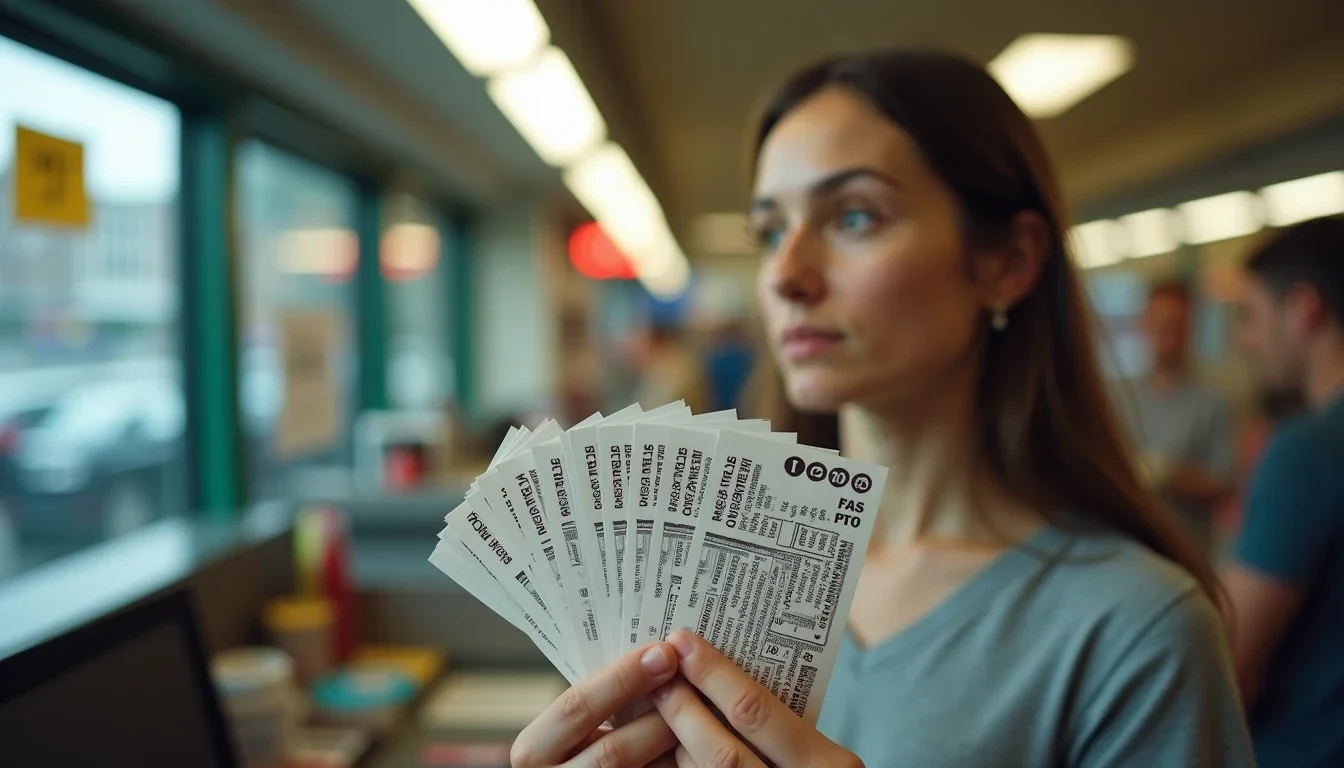
You can buy ten Powerball tickets and tell yourself you are ten times more likely to win. The math agrees, but your gut feeling when those numbers draw does not.
A single Powerball line carries jackpot odds of roughly 1 in 292.2 million. That number is so large it barely registers as real. You know it is bad, but you do not feel how bad. Ten lines shift those odds to about 1 in 29.2 million. A hundred lines get you to 1 in 2.9 million. A thousand lines, 1 in 292,201. Each step is a genuine relative improvement, but none of them bring the prize within emotional reach.
The Ladder of Better Odds That Still Feel Like None
The climb looks like this in practice, with the cost of each rung.
| Lines | Odds | Cost |
|---|---|---|
| 1 | 1 in 292,201,338 | $2 |
| 10 | 1 in 29,220,134 | $20 |
| 100 | 1 in 2,922,013 | $200 |
| 1,000 | 1 in 292,201 | $2,000 |
The relative gains are dramatic. A thousand lines make you a thousand times more likely to win than one line. But the absolute position barely moves. At 1 in 292,201, you still face a probability below 0.00034 percent. Your brain cannot distinguish that from zero in any meaningful way. The difference between “virtually impossible” and “still virtually impossible” does not trigger the sense of possibility that drives hope.
Why Our Minds Refuse the Math
Human intuition collapses when confronted with probabilities at this scale. We evolved to assess immediate threats and local opportunities, not to feel the gap between one in 292 million and one in 29 million. Both sit so far outside ordinary experience that they blur into the same category: not going to happen.
Several biases exploit this blindness. The availability heuristic floods your perception with jackpot winners because their stories dominate headlines and social feeds. The millions who bought ten, a hundred, or a thousand lines and won nothing remain invisible, so winning feels more common than it is. The illusion of control convinces players that choosing their own numbers or increasing volume somehow bends randomness in their favor. It does not. Each Powerball draw is independent. Past losses do not create future debt. The machine owes you nothing.
The Price of Feeling Closer
The cost escalation is linear and brutal. Two dollars for a fantasy is cheap entertainment. Twenty dollars still qualifies as a flutter. Two hundred dollars begins to sting. Two thousand dollars is a used car, an emergency fund, a month of rent in many cities, all converted into a probability that still rounds to zero for any practical purpose.
Players sometimes justify the spend by imagining the jackpot as a solution so complete that any non-zero chance justifies almost any price. This is the same logic that makes a thousand lines feel like a serious play rather than a more expensive way to lose. The fantasy requires the pretense of proximity, but the numbers refuse to cooperate.
What “Ten Times More Likely” Actually Means
Consider the analogies that make these odds tangible. Winning Powerball with one ticket is roughly equivalent to picking one specific person out of the entire population of the United States. Ten tickets improve your position, but you are still hunting one person among a crowd of thirty-three million. A thousand tickets narrow it further, yet you remain searching through a city-sized group for a single face you have never seen.
The relative framing, “ten times more likely,” is technically accurate and psychologically misleading. It sounds like momentum and feels like progress, but it is neither. The absolute probability remains anchored in a realm where human intuition cannot operate. The emotional reward of buying more tickets, the brief lift of holding a thicker stack, fades the moment the draw begins.
The Real Game Being Played
Lotteries understand this perfectly. They market the jackpot, not the odds. They sell the moment between purchase and result, the hours where you inhabit a world that contains your win as a theoretical possibility. Extra tickets extend that moment and deepen the fantasy without altering its foundation.
The honest transaction would acknowledge that one ticket and a thousand tickets share the same emotional outcome for nearly every player: a brief suspension of disbelief, followed by a return to ordinary life. The thousand-ticket buyer pays more for the same arc.
This is not an argument against playing. It is an argument against playing under false pretenses. If you buy one Powerball ticket, you are purchasing a night of imagining what you would do with eight hundred million dollars. That has a value. If you buy a hundred tickets, you are purchasing the same night at a hundred times the price, with a probability improvement so slight that your imagination cannot perceive it. The jackpot does not draw closer; only the cost does.